In engineering, energy is the capacity of a system to make something happen. It is measured in Joules (J). Energy cannot be created or destroyed — only transferred or transformed from one form to another. This is the Law of Conservation of Energy.
Energy cannot be created or destroyed — it can only be converted from one form to another.
Forms of energy
⚡
Electrical
Energy carried by moving electrons in a circuit — e.g. current from a battery or mains supply
🏃
Kinetic
Energy of a moving object — the faster it moves or the heavier it is, the more kinetic energy it has
📏
Potential (gravitational)
Energy stored in an object due to its height — the higher it is, the more potential energy it has
🔥
Thermal (heat)
Energy stored in a warm object — transferred when objects at different temperatures are in contact
💪
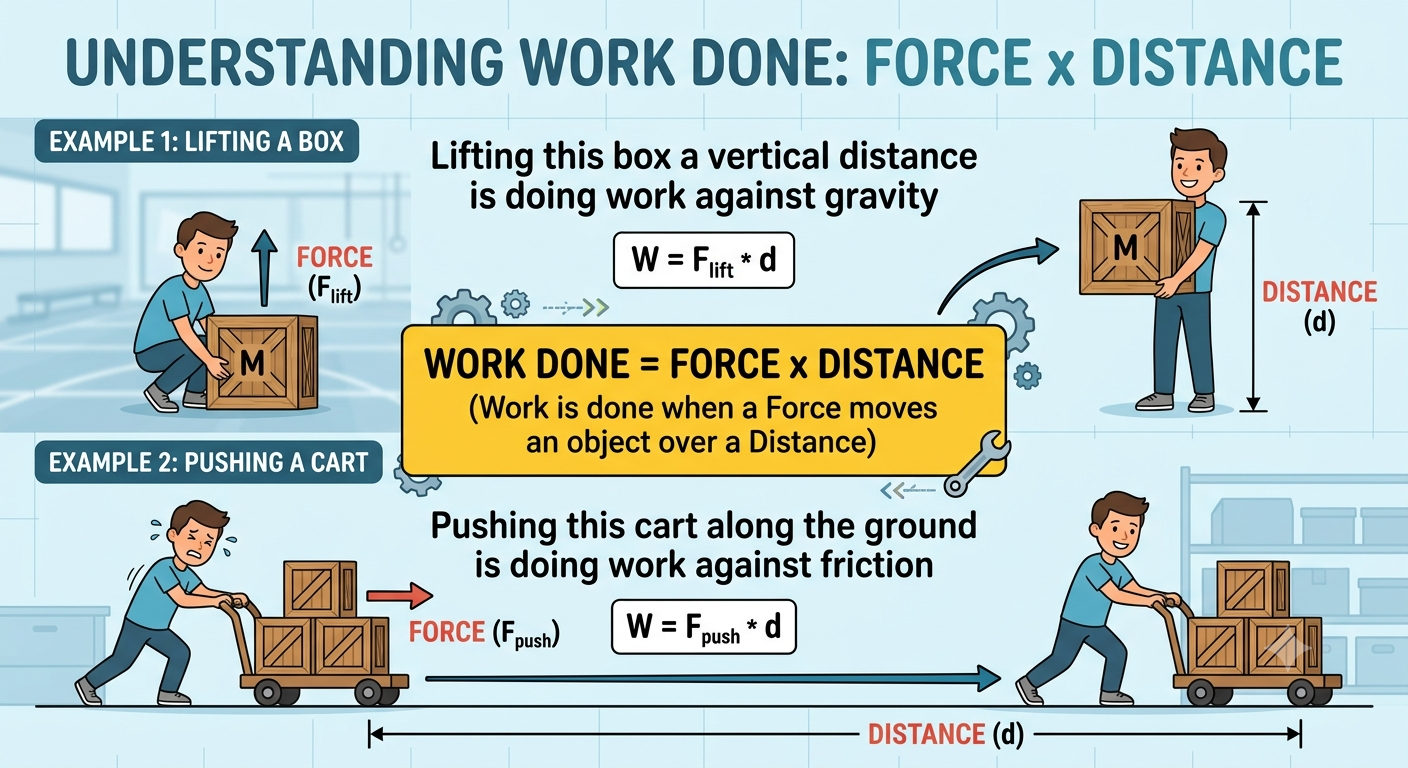
Work Done
Energy transferred when a force moves an object through a distance — e.g. pushing a car
🧪
Chemical
Energy stored in chemical bonds — released by burning fuel or in a battery reaction
🌞
Light
Energy carried by electromagnetic waves — e.g. from a lamp, LED or the sun
🔈
Sound
Energy carried by vibrations through a material — e.g. from a speaker or engine
⚛️
Nuclear
Energy released when atomic nuclei split (fission) or join (fusion) — e.g. nuclear power stations
🌀
Strain (elastic)
Energy stored in a stretched or compressed object — e.g. a spring, elastic band or car suspension
📝 Exam focus: For N5 calculations you need to be able to work with five types of energy: Electrical (Ee), Kinetic (Ek), Gravitational Potential (Ep), Work Done (Ew) and Heat (Eh). These are covered in Sections 2–6.
Where does energy come from?
Virtually all energy on Earth originally comes from the Sun. There are three main sources:
Fossil fuels (coal, oil, gas, peat) — formed from ancient living matter that stored solar energy through photosynthesis. Non-renewable.
Renewable sources (wind, wave, solar, tidal, hydro, geothermal) — replenished naturally. Scotland is a world leader in wind and hydro power.
Nuclear fuels (uranium) — energy from splitting atoms (fission). Very high energy density but produces radioactive waste.
✏️ Task 1 — Identifying forms of energy
1. For each device, state the main input energy and the main output energy (and any unwanted energy output).
a) Hair straighteners
Answer ✓ Saved
b) Stretched elastic band released to flick a paper ball
Answer ✓ Saved
c) Wind turbine
Answer ✓ Saved
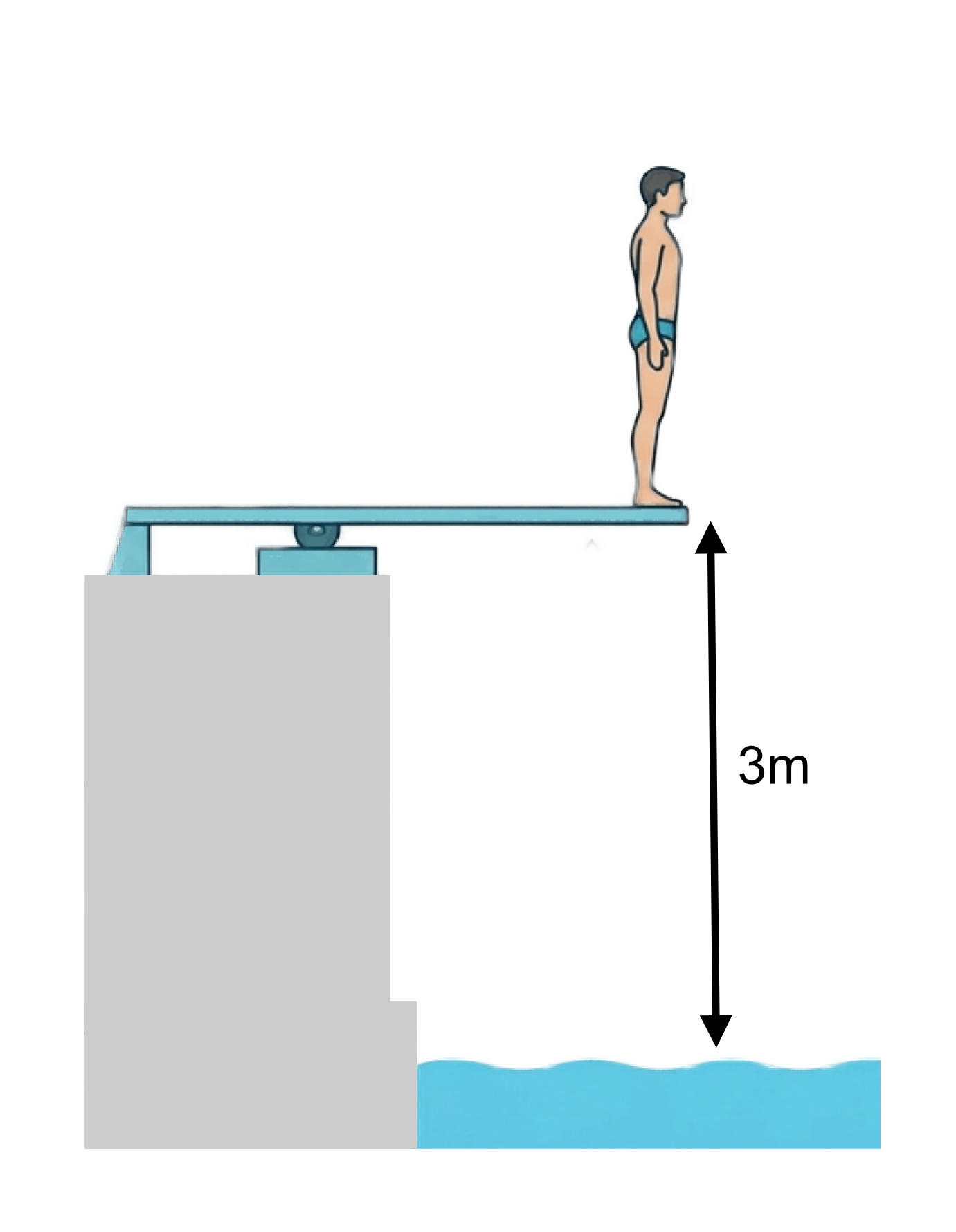
2. An Olympic diver jumps upward from a 3 m springboard above the pool.
a) What type of energy does the diver possess while standing on the springboard?
Answer ✓ Saved
b) As the diver rises into the air after jumping, what form of energy do they gain?
Answer ✓ Saved
c) At the highest point of the dive, why does the diver have no kinetic energy?
Answer ✓ Saved
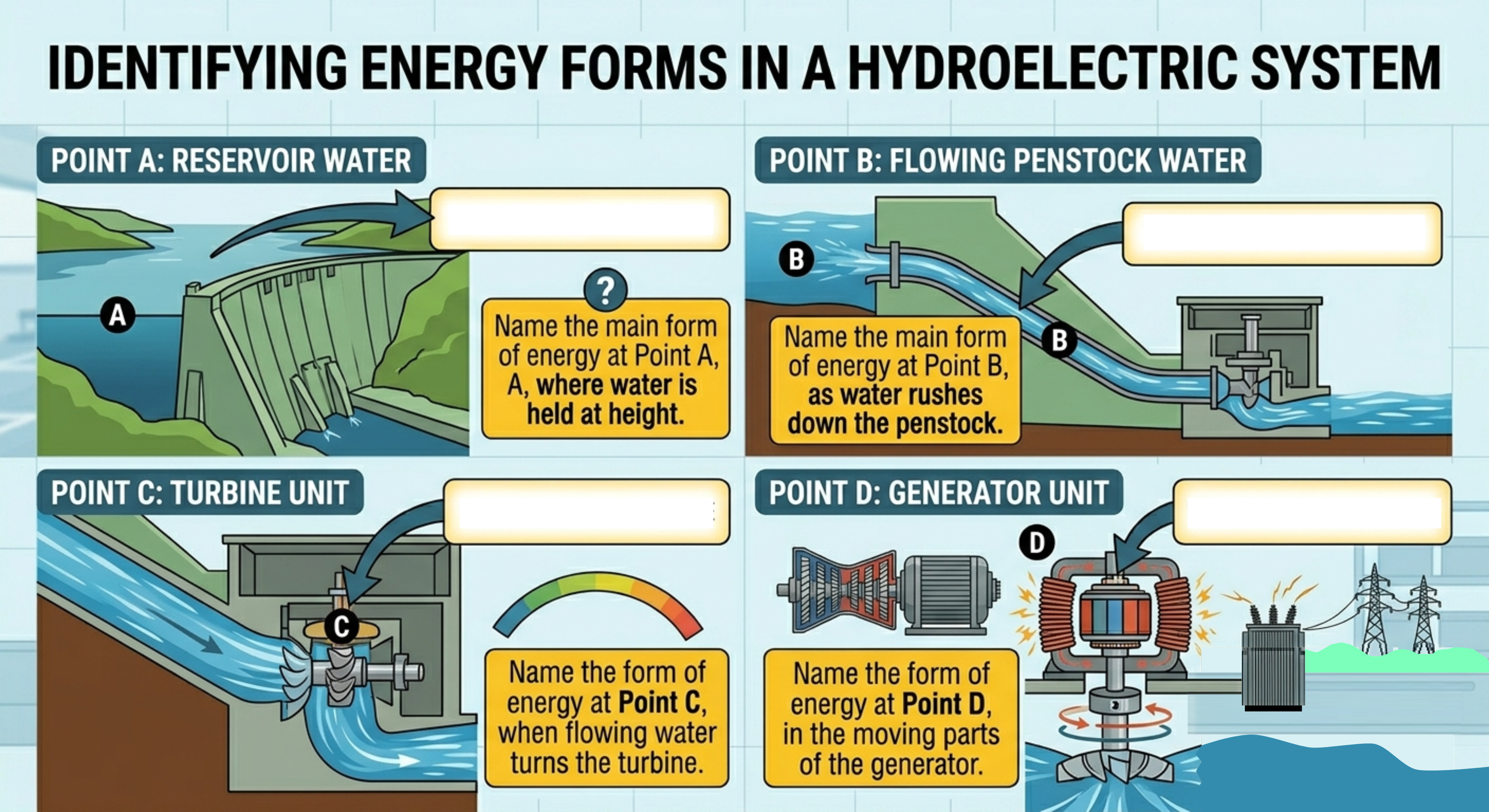
3. A hydroelectric power station has water in a reservoir (A), water flowing through a pipe called a penstock (B), a turbine (C) and a generator (D). Name the form of energy at each point — click each yellow box to type your answer.
Answers saved automatically as you type
Section 2: Work Done (Ew)
Work is done when a force moves an object. The amount of work depends on the size of the force and the distance moved. Work is measured in Joules (J).
Ew = F × d
Ew = work done (J) F = force (N) d = distance (m)
Rearranged: F = Ewd d = EwF
Worked Example — Work done
A force of 6 kN is used to push a car a distance of 25 m. Calculate the work done.
1
Known values: F = 6000 N, d = 25 m
2
Formula: Ew = F × d
3
Solve: Ew = 6000 × 25 = 150 000 J = 150 kJ
✏️ Task 2 — Work done calculations
1. Calculate the work done when a force of 150 N pulls a bag of sand 20 m.
Working ✓ Saved
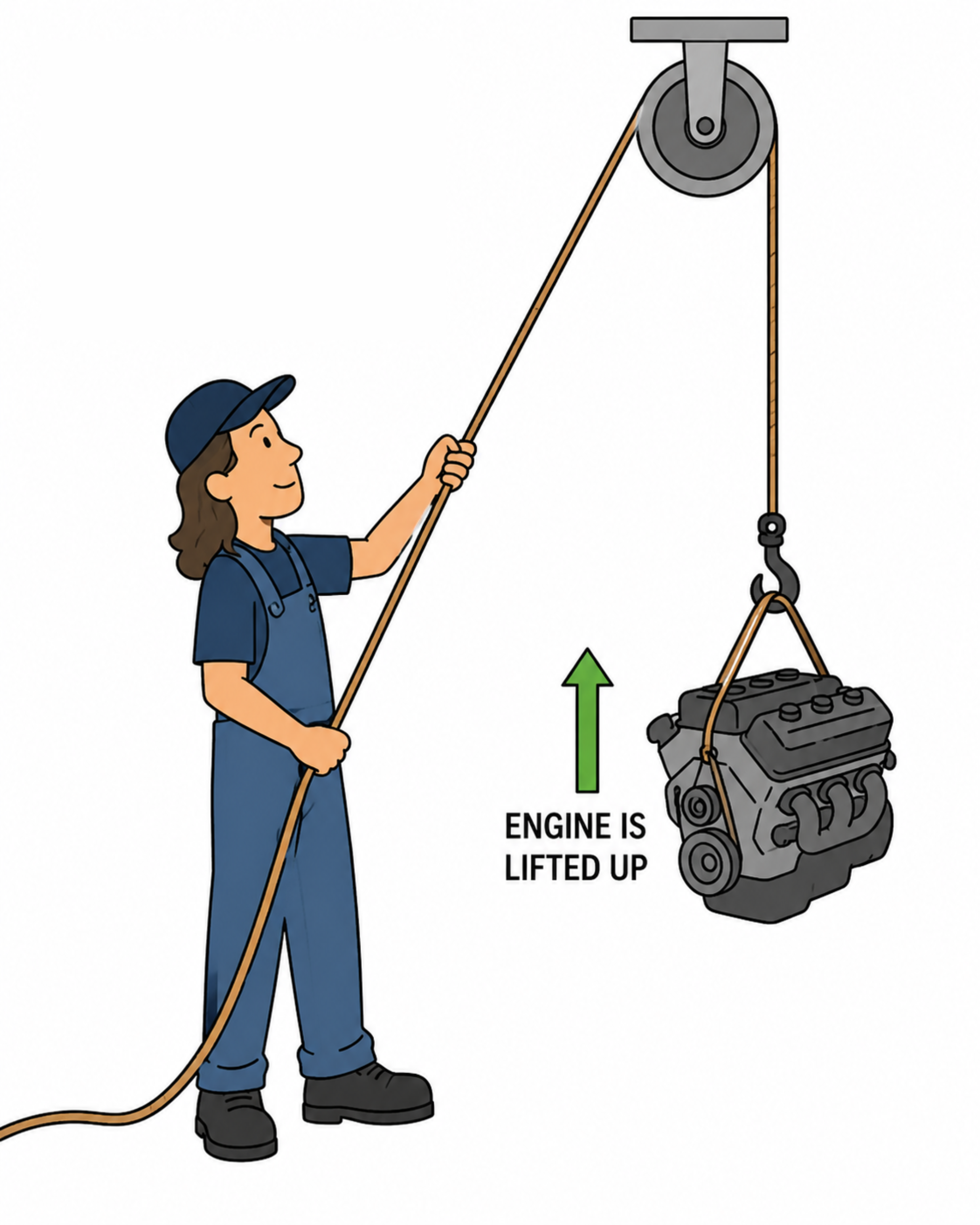
2. A mechanic uses a lifting mechanism to take a small engine out of a car. They apply a 240 N force to pull 2 m of rope. Calculate the work done.
Working ✓ Saved
3. A forklift truck lifts a pallet of bricks 2 m using a force of 7.2 kN. Calculate the work done.
Working ✓ Saved
4. During a test on Edinburgh's tram network, 29 kJ of work is done to move the tram along a 150 m stretch of track. What force does the tram motor exert?
Working ✓ Saved
5. An offshore drilling rig exerts a constant force of 63 kN. After a period of drilling, 192 kJ of energy has been consumed. How far has the drill travelled?
Working ✓ Saved
Section 3: Potential Energy (Ep)
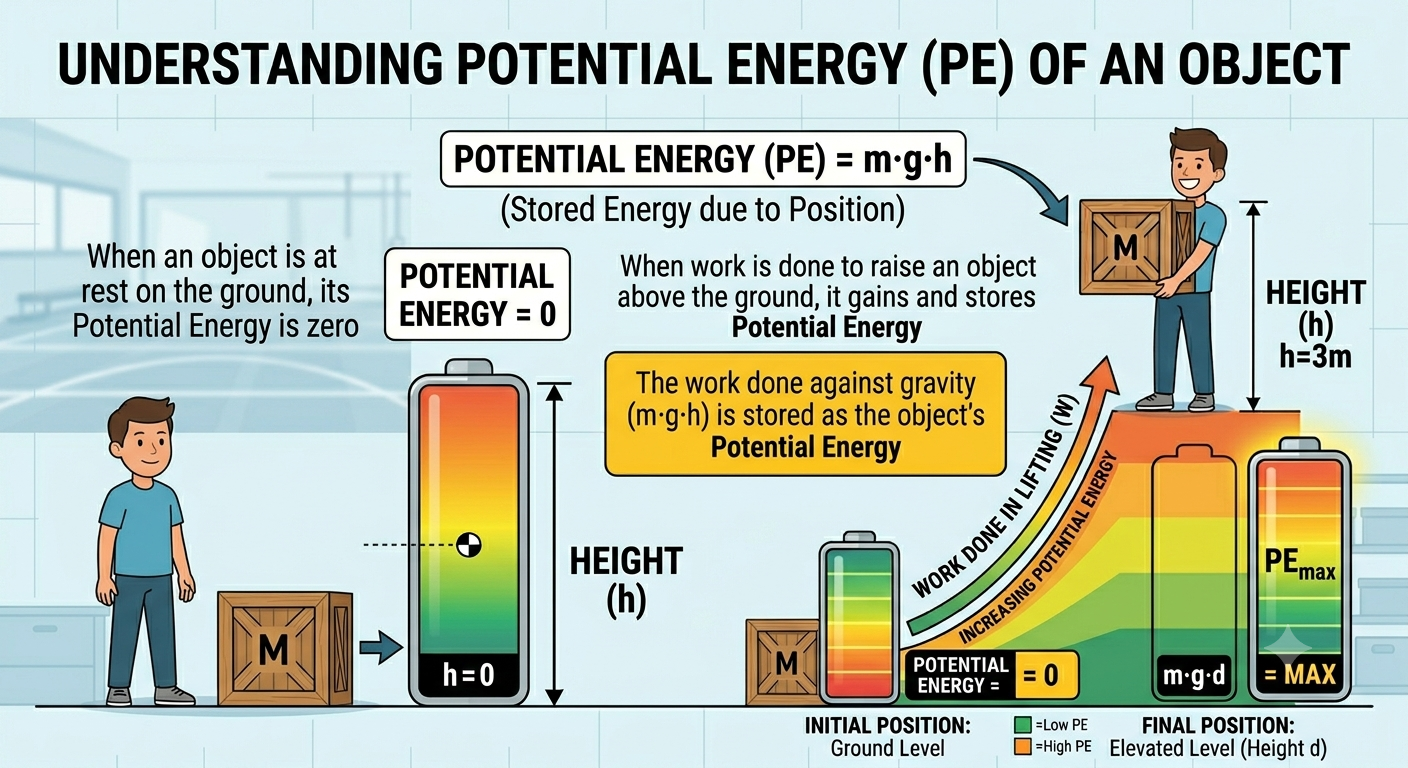
Potential energy is the energy stored in an object due to its height above the ground. When work is done to lift an object, that energy is stored as potential energy.
Ep = m × g × h
Ep = potential energy (J) m = mass (kg) g = 9.8 m/s² h = height (m)
Worked Example — Potential energy
A winch raises a 100 kg mass. Calculate the potential energy stored when it reaches 20 m.
1
Ep = m × g × h = 100 × 9.8 × 20 = 19 600 J
✏️ Task 3 — Potential energy calculations
1. Baggage handlers at an airport lift a 20 kg suitcase 3.5 m up a conveyor belt. Calculate the potential energy stored.
Working ✓ Saved
2. A steel cable drum of mass 100 kg is suspended above the ground on a construction site and has 4 kJ of potential energy. At what height above the ground is it suspended?
Working ✓ Saved
3. A water tank holds 1800 litres of water at a height of 260 m above a turbine. Calculate the potential energy stored. (1 litre of water has a mass of 1 kg.)
Working ✓ Saved
4. A fairground rollercoaster reaches a highest point 50 m above ground and a lowest point 5 m above ground. Calculate the potential energy for an 80 kg person at the highest and lowest points, and the change in potential energy between them.
Working ✓ Saved
Section 4: Kinetic Energy (Ek)
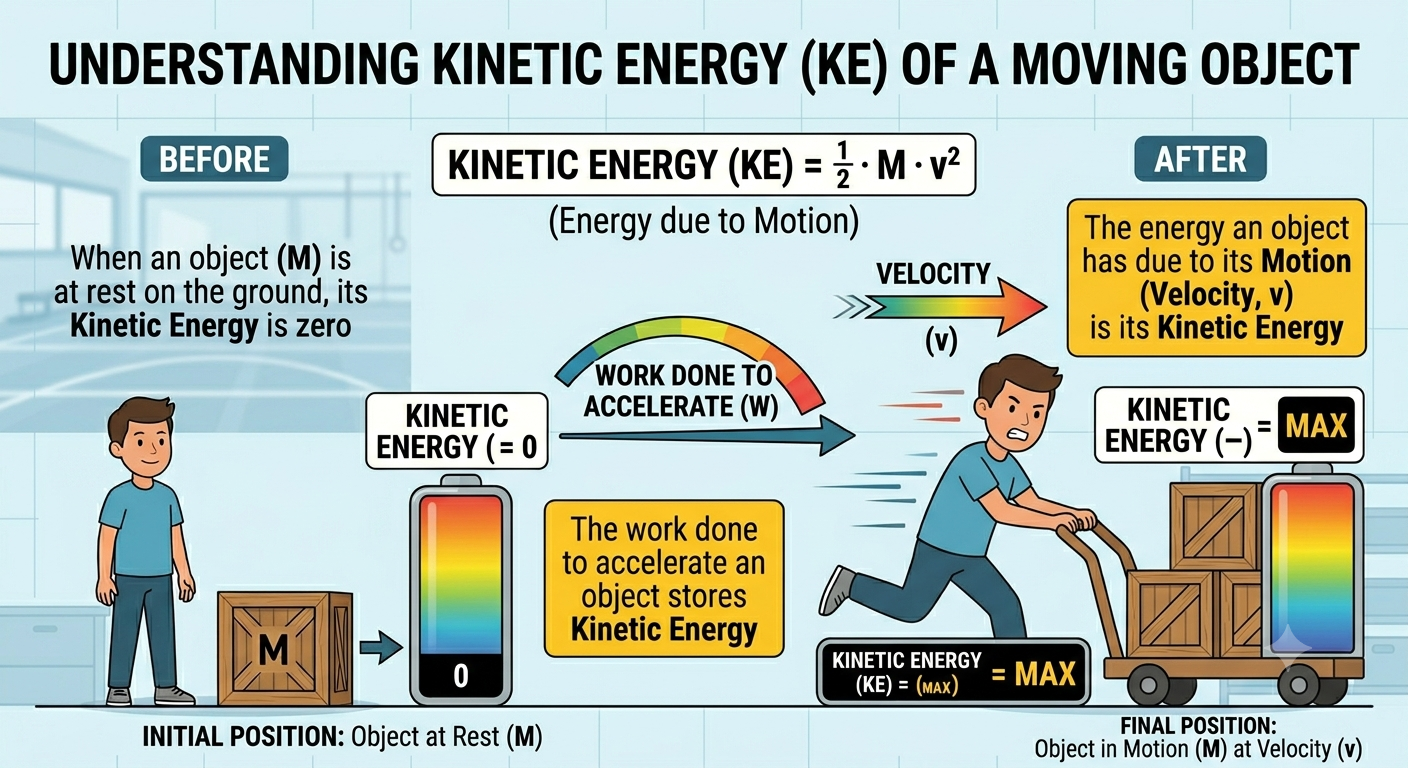
Kinetic energy is the energy of movement. Any moving object has kinetic energy. It depends on two factors: the mass of the object and its velocity.
Ek = ½ × m × v²
Ek = kinetic energy (J) m = mass (kg) v = velocity (m/s)
Worked Example — Kinetic energy
A go-kart with a mass of 90 kg travels at 4 m/s. Calculate its kinetic energy.
1
Ek = ½ × m × v² = ½ × 90 × 4²
2
= ½ × 90 × 16 = 720 J
✏️ Task 4 — Kinetic energy calculations
1. When making sheets of steel for manufacturing, 50 kg ingots of metal travel along rollers at 0.5 m/s. Calculate the kinetic energy of each ingot.
Working ✓ Saved
2. A racing car travels at 50 m/s and has a kinetic energy of 500 kJ. Calculate the mass of the car.
Working ✓ Saved
3. A girl and her bicycle have a combined mass of 50 kg and 2.5 kJ of kinetic energy. Calculate their velocity.
Working ✓ Saved
4. A travelator (moving walkway) at an airport carries six people with a total mass of 500 kg at a speed of 0.5 m/s. What is the total kinetic energy of the six people?
Working ✓ Saved
Section 5: Electrical Energy (Ee)
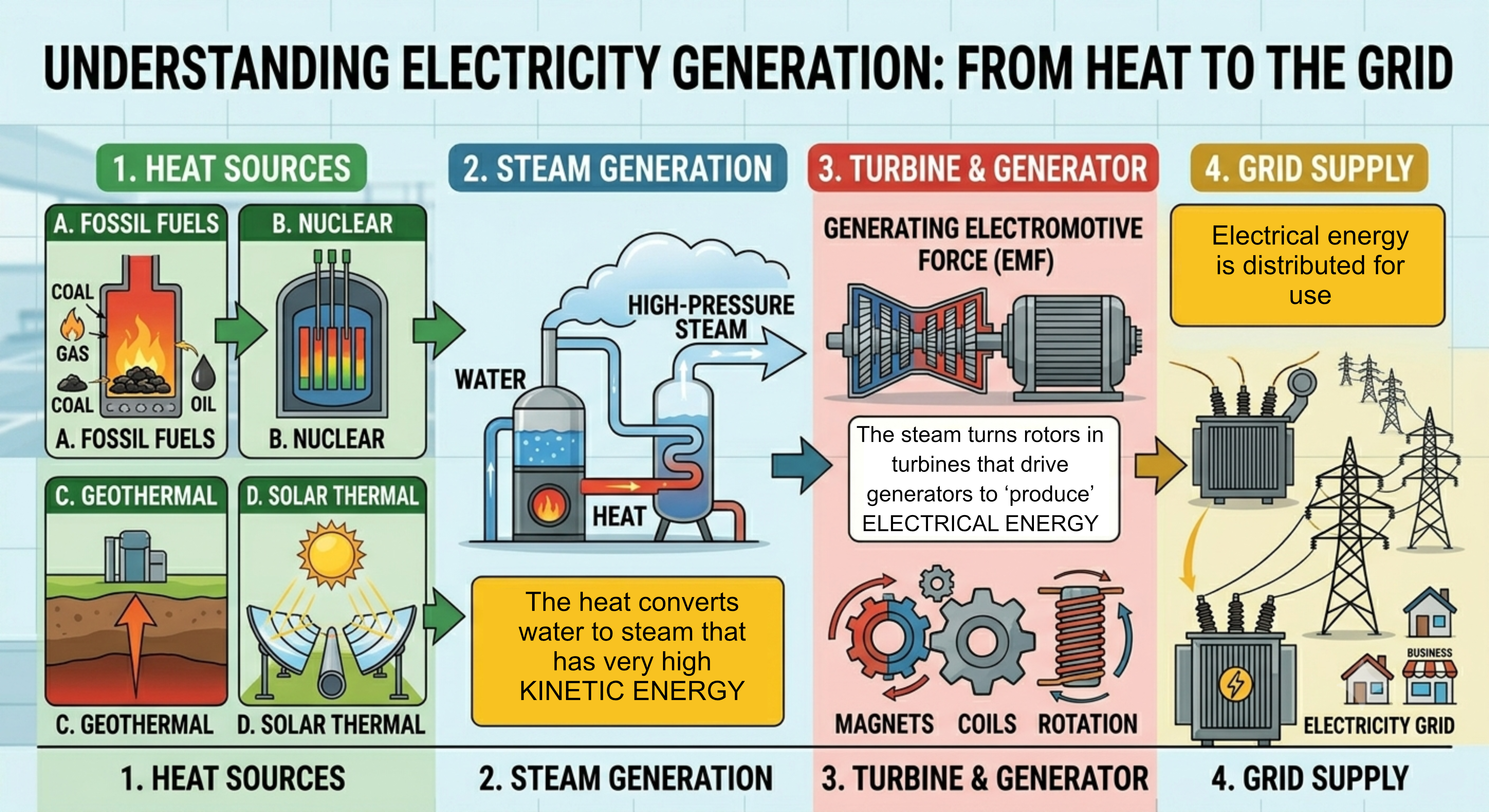
Electrical energy is one of the most useful forms of energy because it can be transported easily along cables and converted into almost any other form.
How is electrical energy generated?
Most of our electrical energy is created in a similar way, regardless of the fuel used:
This process is used with coal, gas, oil and nuclear fuel. To reduce climate change, we want to use renewable sources — major sources such as wind, solar and hydro power generate electricity in different ways but do it without the pollution caused by burning fossil fuels.
Ee = V × I × t
Ee = electrical energy (J) V = voltage (V) I = current (A) t = time (s)
Worked Example — Electrical energy
An electric cooking ring operates at 230 V with a current of 5 A. Calculate how much electrical energy is used in 5 minutes to heat soup.
1
Convert time: 5 minutes = 5 × 60 = 300 s
2
Ee = V × I × t = 230 × 5 × 300 = 345 000 J = 345 kJ
✏️ Task 5 — Electrical energy calculations
1. A hot-air hand drier operates from 230 V and draws 12 A for 30 seconds. Calculate the electrical energy used.
Working ✓ Saved
2. A portable generator delivers 6 kJ per second at 110 V. Calculate the current it can supply.
Working ✓ Saved
3. A 110 V, 30 A motor uses 1.98 MJ of electrical energy. Calculate how long the motor has been operating for.
Working ✓ Saved
4. A 12 V car battery has a capacity of 35 amp-hours (Ah). Calculate the total electrical energy it can supply. (Hint: 1 amp-hour = 3600 coulombs, so 35 Ah = 35 × 3600 A·s — use this as your I × t value.)
Working ✓ Saved
Section 6: Heat Energy (Eh)
Heat energy (thermal energy) is the energy transferred to a body that results in a change in temperature. The amount of heat energy needed depends on the mass of the material, the temperature rise required, and the specific heat capacity of the material — a fixed property of each material.
Eh = m × c × ΔT
Eh = heat energy (J) m = mass (kg) c = specific heat capacity (J/kg·K) ΔT = temperature change (°C), where Δ (pronounced “DEL-ta”) means “change in”
The specific heat capacity of water is 4180 J/kg·K. This value will be given to you in the Qualifications Scotland Data Booklet in the exam.
Worked Example — Heat energy
A hot water tank contains 200 litres of water at 18°C. How much energy is needed to heat it to 50°C? (c = 4180 J/kg·K)
1. Calculate the heat energy required to raise the temperature of 2 kg of water from 20°C until it begins to boil (100°C). (cwater = 4180 J/kg·K)
Working ✓ Saved
2. A central heating radiator contains 3 kg of water. Calculate the heat energy needed to raise the water temperature from 15°C to 65°C. (cwater = 4180 J/kg·K)
Working ✓ Saved
3. A steel component of mass 0.5 kg is heated in a furnace. The specific heat capacity of steel is 500 J/kg·K. If 25 000 J of heat energy is supplied, calculate the temperature rise.
Working ✓ Saved
4. A hall measures 8 m × 30 m × 10 m. Calculate the heat energy required to raise the air temperature from 10°C to 20°C. (Density of air = 1.3 kg/m³, cair = 850 J/kg·K) (Multi-step challenge — find the mass of air first)
Working ✓ Saved
Section 7: Energy Transfers and Energy Audits
At every stage in a system, energy is transferred from one body to another or transformed into a different type of energy. In an ideal system, all energy would be converted to the useful output form — but in practice, some is always lost, usually as heat.
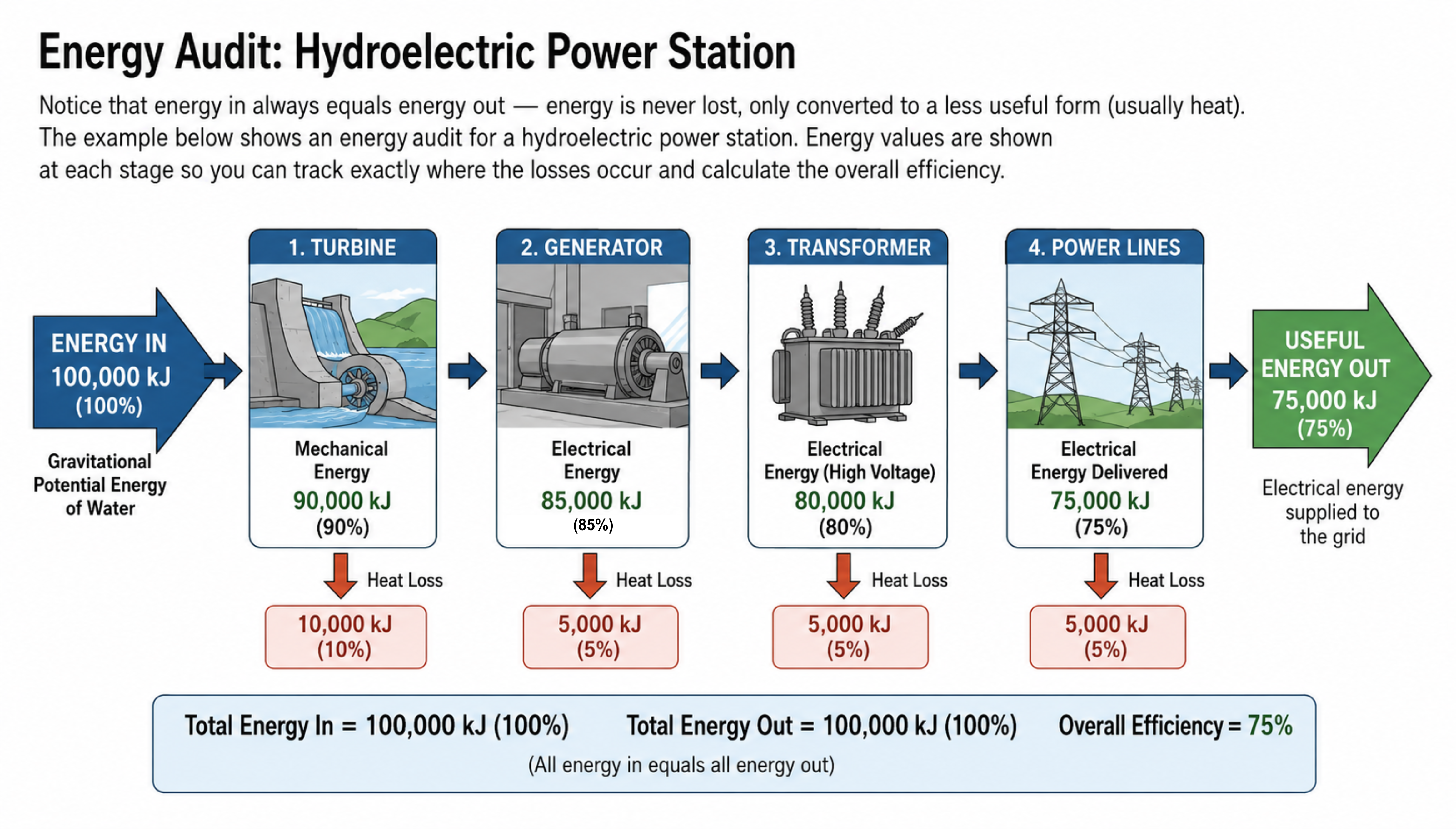
An energy audit is a sub-systems diagram that shows how much energy enters and leaves each sub-system, including energy losses at each stage.
The example below shows a full energy audit for a hydroelectric power station, tracked through all four stages of generation: the turbine, the generator, the transformer, and the power lines.
📌
Diagram coming soon — energy-audit-new.png
Add this file to the images/ folder to display it here.
Working through the diagram stage by stage: the water's gravitational potential energy (100,000 kJ) drives the turbine, but 10% is lost to friction and turbulence, leaving 90,000 kJ of mechanical energy. The generator converts most of this to electrical energy, losing a further 5,000 kJ, mainly as heat in the windings. The transformer then steps the voltage up for transmission, losing another 5,000 kJ, and the power lines themselves lose a final 5,000 kJ as heat due to electrical resistance. By the time it reaches the grid, only 75,000 kJ of the original 100,000 kJ remains as useful electrical energy — an overall efficiency of 75%.
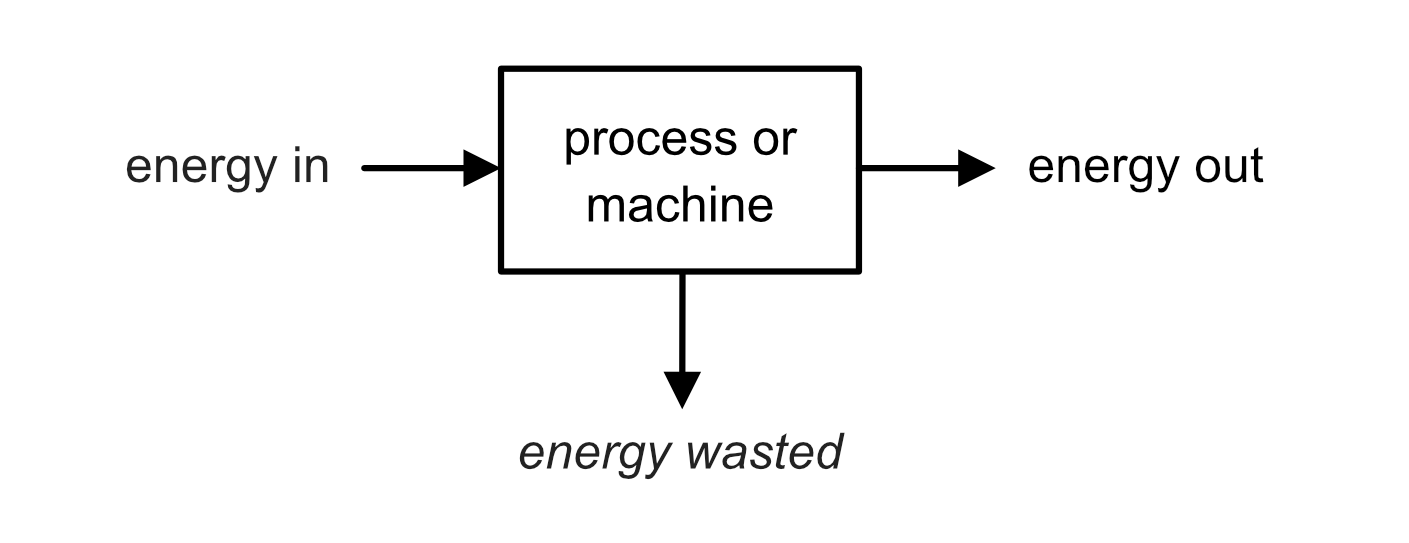
The format of energy audit diagrams used by Qualifications Scotland is shown below. Energy enters from the left, useful energy exits to the right, and wasted energy exits downward from the process or machine box.
📌
Diagram coming soon — energy_audit_generic.png
Add this file to the images/ folder to display it here.
✏️ Task 7 — Energy transfers and audits
1. For each system, complete the energy audit diagram. Write the type of energy in each box — input energy on the left, useful output on the right, and wasted energy below the process box.
a) Electric kettle
b) Wind-up toy car
c) Stretched elastic band released to flick a paper ball
d) A hydroelectric power station
2. A torch uses a 3 V battery that supplies 0.5 A. The bulb produces 1.2 W of light energy. Complete an energy audit: calculate the electrical power input, the useful light output, and the power lost as heat. Show the values on a systems diagram.
Working and diagram ✓ Saved
Section 8: Efficiency
Efficiency is a measure of how much of the input energy is converted to useful output energy. It is always less than 100% because some energy is always lost (usually as heat). Efficiency can be calculated using energy values or power values.
η = EoutEin × 100%
Also valid: η = PoutPin × 100% η (pronounced “EE-ta”) = efficiency (%) E = energy (J) P = power (W)
Worked Example — Efficiency
A motor receives 500 J of electrical energy and produces 375 J of mechanical energy. Calculate its efficiency.
1
η = EoutEin × 100 = 375500 × 100 = 75%
2
The remaining 25% (125 J) is lost as heat due to friction and resistance in the motor.
✏️ Task 8 — Efficiency calculations
1. A pump receives 2000 J of electrical energy and raises water giving it 1400 J of potential energy. Calculate the efficiency of the pump.
Working ✓ Saved
2. A lamp has a power input of 60 W and a light output of 15 W. Calculate the efficiency. State in what form the remaining energy is lost.
Working ✓ Saved
3. An electric motor receives 800 J of electrical energy and produces 560 J of kinetic energy. Calculate the efficiency of the motor and state where the remaining energy is lost.
Working ✓ Saved
4. A deep fat fryer uses 2 kJ of electrical energy every second and takes 6 minutes to complete a cooking cycle. If 480 kJ of heat energy is transferred to the oil, how efficient is the fryer?
Working ✓ Saved
5. A new petrol engine is 64% efficient and produces 520 J of output. Calculate the input energy to the engine.
Working ✓ Saved
6. A hydroelectric power station energy audit shows: the reservoir has 500 kJ of potential energy. 20 kJ is lost to friction in the penstock pipe; 18 kJ is lost in the turbine bearings; 44 kJ is lost in the generator windings. Calculate: (a) the kinetic energy entering the turbine; (b) the kinetic energy entering the generator; (c) the electrical energy output; (d) the overall efficiency of the power station.
Working ✓ Saved
Section 9: Power
Power is the rate at which energy is transferred — how quickly energy is used or produced. It is measured in Watts (W), named after the Scottish engineer James Watt. 1 W = 1 J per second.
P = Et
P = power (W) E = energy (J) t = time (s)
Rearranged: E = P × t t = EP
Worked Example — Power
An electric light bulb uses 60 kJ of energy in 10 minutes. What is its power rating?
1
Convert: E = 60 000 J, t = 10 × 60 = 600 s
2
P = Et = 60 000600 = 100 W
✏️ Task 9 — Power calculations
1. A 60 W light bulb is switched on for 20 seconds. How much energy does it use?
Working ✓ Saved
2. An electric motor consumes 18 kJ in 1 minute. What is the power developed by the motor?
Working ✓ Saved
3. A car stereo operates at 15 W. During a 10 minute journey it draws energy from the battery. Calculate the total energy used.
Working ✓ Saved
4. A winch lifts a 500 kg pallet of bricks to a height of 10 m in 15 seconds. Calculate the minimum output power from the winch.
Working ✓ Saved
5. An electric heater rated at 3 kW is switched on. Calculate how much heat energy it produces in one hour.
Working ✓ Saved
6. A hydroelectric station reservoir contains 60 MJ of potential energy. The generator is 65% efficient. Calculate how much electrical energy could be generated. Suggest where the remaining energy may be lost.
Working ✓ Saved
Section 10: Renewable and Non-Renewable Energy
In the context of engineering, understanding where energy comes from is important for designing sustainable systems.
Non-renewable sources
Fossil fuels (coal, oil, gas) cannot be replaced on human timescales. Burning them releases CO2 and other greenhouse gases, contributing to climate change. They will eventually run out.
Renewable sources
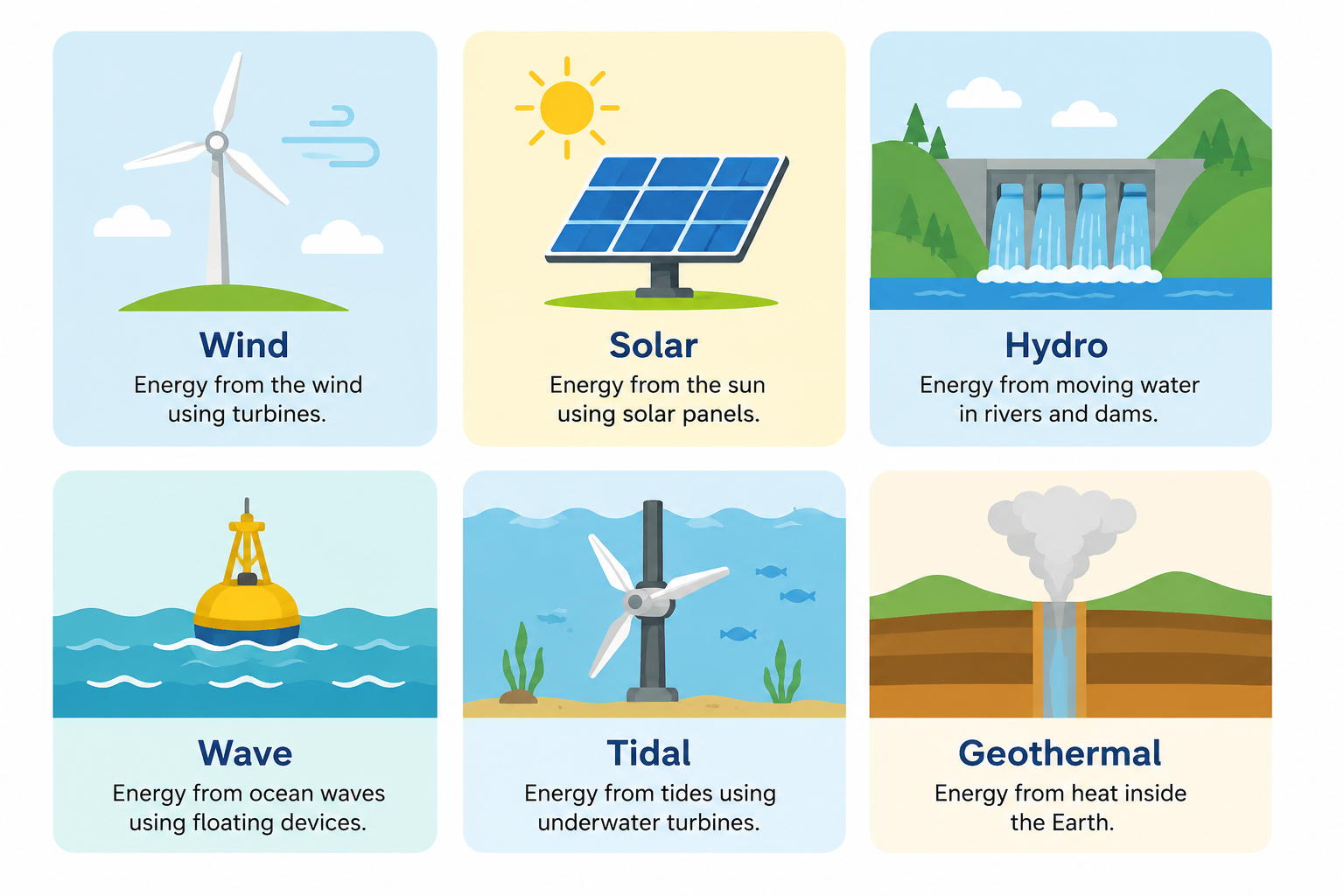
Renewable energy sources are naturally replenished. They produce little or no carbon emissions and will not run out.
📌
Diagram coming soon — energy-renewables-grid.png
Add this file to the images/ folder to display it here.
✏️ Task 10 — Renewable energy sources
1. Research each renewable energy source below. Complete the table to show how each one works and its main limitations. Use the internet, textbooks or the Energy and Efficiency course notes to help you.
Renewable source
How it works
Limitations
Wind
Solar
Hydropower
Wave
Tidal
Geothermal
2. Explain why a single renewable energy source may not be enough to supply an entire country with electricity. Why do we need a mix of renewable sources?
Answer ✓ Saved
Section 11: Design Challenges
Each challenge below follows the same cycle you will use in your assignment: read the context, check the specification, then work through four parts — (a) analyse the system, (b) use calculations to make a design decision, (c) test the design using results or new conditions, and (d) evaluate the design against every point of the specification.
Every value is already in the units the formulas need (kg, m, s, J, V, A, °C), so no unit conversion is needed. Use g = 9.8 N/kg and cwater = 4180 J/kg·K where required.
Design Challenge 1: Expedition kettle
🛠️ Design Challenge 1 — Expedition kettle
A group of S4 pupils is planning a Duke of Edinburgh expedition in the Cairngorms. They want to avoid carrying gas canisters, so they plan to build a small electric kettle that runs from a rechargeable 12 V power pack. You have been asked to choose a heating element and check whether the design works.
Specification
i
The kettle must heat 0.25 kg of water (one mug) from 10 °C to 90 °C.
ii
It must run from the 12 V power pack, which can supply a maximum current of 15 A.
iii
The water must reach 90 °C in 900 s or less.
iv
The kettle must be at least 70% efficient.
Heating elements available
Element
Supply voltage
Current drawn
A
12 V
8 A
B
12 V
12 A
C
12 V
20 A
(a) Complete the energy audit diagram for the kettle. Write the type of energy in each box.
(b) Calculate the heat energy needed to meet specification point i. Then calculate the minimum electrical input power needed to meet points iii and iv. Use your answer to choose element A, B or C, and explain why you rejected the other two.
Working and choice ✓ Saved
(c) A prototype is built with element B and tested. It heats 0.25 kg of water from 10 °C to 90 °C in 820 s. Calculate the electrical energy supplied during the test and the efficiency of the prototype.
Working ✓ Saved
(d) Evaluate the prototype against each point of the specification, using your test results as evidence. Suggest one modification that would improve the kettle’s efficiency, and explain how it reduces wasted energy.
Evaluation ✓ Saved
Design Challenge 2: Stage scenery winch
🛠️ Design Challenge 2 — Stage scenery winch
A school drama department wants to “fly” a painted scenery flat up into the roof space between scenes, so it disappears from view. At the moment two pupils haul it up by hand on a rope. You have been asked to specify an electric motor for a winch to do the job.
Specification
i
The winch must lift a scenery flat of mass 40 kg through a height of 6 m.
ii
The lift must take 12 s or less, so it fits within a scene change.
iii
The motor must run from the stage’s 24 V supply.
iv
To keep cost and noise down, the lowest-power motor that meets points i to iii must be chosen.
v
The flat must stay safely in the roof space if the power fails.
Design data
The supplier states that the complete winch system (motor, gearbox and pulleys) is 60% efficient.
Motor
Supply voltage
Maximum current
X
24 V
10 A
Y
24 V
15 A
Z
24 V
25 A
(a) Describe the energy changes in the winch system, from the electrical supply to the flat resting in the roof space. Name two forms of wasted energy and where each one is produced.
Answer ✓ Saved
(b) Calculate the potential energy gained by the flat, the useful output power needed to meet point ii, and the electrical input power needed. Work out the current the motor must draw from the 24 V supply, then choose motor X, Y or Z and justify your choice using point iv.
Working and choice ✓ Saved
(c) The winch is built with motor Y and tested. It lifts the flat through 6 m in 11 s, drawing 14 A from the 24 V supply. Calculate the electrical energy used and the actual efficiency of the winch system. Compare this with the supplier’s figure.
Working ✓ Saved
(d) Evaluate the winch against points i to iv. For point v, explain what happens to the flat’s potential energy if the motor loses power at the top, and suggest a feature that would keep the stage safe.
Evaluation ✓ Saved
Design Challenge 3: Micro-hydro for a mountain bothy
🛠️ Design Challenge 3 — Micro-hydro for a mountain bothy
A remote Highland bothy has no mains electricity, and fuel has to be carried in on foot. A stream runs down the hillside just above it. A volunteer group wants to pipe some of the stream through a small turbine and generator, then send the electricity along a cable to the bothy for LED lighting and a charging point for phones and emergency radios.
Specification
i
At normal stream flow, the system must deliver at least 80 W to the bothy (60 W of lighting plus a 20 W charging point).
ii
It must not need any fuel to be delivered.
iii
During a dry spell, it must still deliver enough power for the 60 W of lighting.
Design data
Item
Value
Height the water falls through the pipe
8 m
Mass of water through the pipe each second (normal flow)
2 kg
Mass of water through the pipe each second (dry spell)
1.5 kg
Turbine efficiency
70%
Generator efficiency
80%
Cable efficiency (turbine house to bothy)
95%
(a) Complete the energy audit for the system. Write the form of energy passing along each arrow, and the main form of energy wasted at each stage.
(b) At normal flow, calculate the potential energy given up by the water falling through the pipe each second. Because this happens every second, your answer in joules is also the power available in watts. Then calculate the power leaving each stage and the overall efficiency of the system.
Working ✓ Saved
(c) Test the design against a dry spell, when only 1.5 kg of water passes through the pipe each second. Calculate the power delivered to the bothy under these conditions.
Working ✓ Saved
(d) Evaluate the system against each point of the specification. The volunteers want the charging point to keep working in a dry spell, because the emergency radios depend on it. Suggest a change to the system that would achieve this, and justify it using what you learned in Section 10.
Evaluation ✓ Saved
💾 Answers saved automatically in this browser on this device.