Section 1: Material Categories
Engineers must choose the most appropriate material for every part of a design. The choice depends on what the part needs to do, what forces it will experience, and the environment it will operate in. Materials are grouped into four main categories:
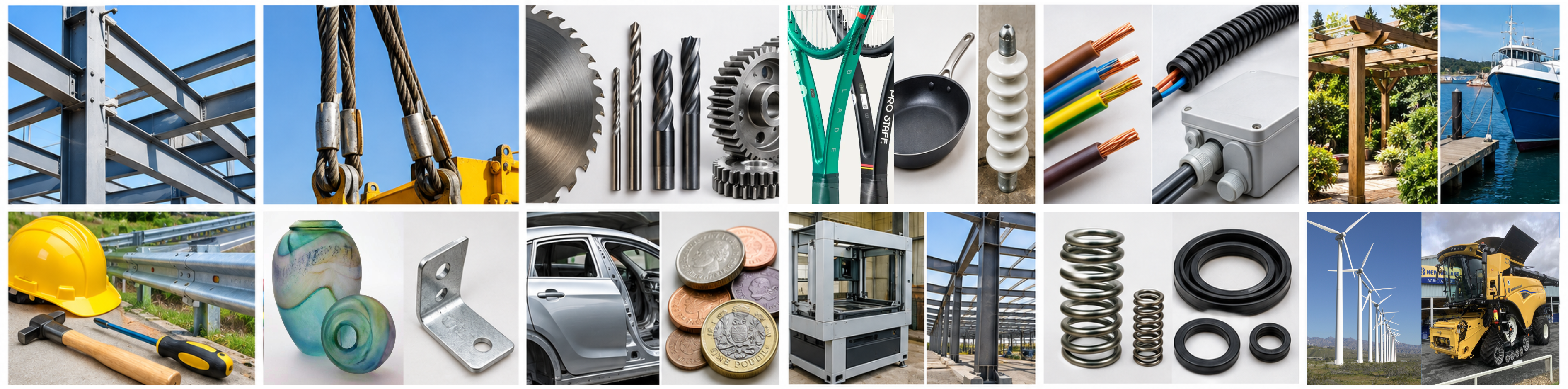
- Steel — structural beams, car bodies, tools
- Aluminium — aircraft, packaging, bike frames
- Copper — electrical wiring, plumbing
- Titanium — aerospace, medical implants
- Polyethylene (PE) — plastic bags, bottles
- Polypropylene (PP) — food containers, rope
- Nylon — gears, bearings, textiles
- Acrylic — signs, windows, displays
- Glass — windows, lenses, optical fibre
- Concrete — foundations, roads, bridges
- Porcelain — electrical insulators, tiles
- Silicon carbide — cutting tools, brake discs
- Carbon fibre reinforced polymer (CFRP) — aircraft, F1 cars, bikes
- Glass fibre (GRP/fibreglass) — boat hulls, helmets
- Reinforced concrete — buildings, bridges
Section 2: Material Properties
To choose the right material, engineers consider a range of mechanical, physical and other properties. Understanding these properties allows you to justify a material choice in the exam.
Key properties — make sure you can describe each of these and use them to justify a material choice:
| Property | Definition | Example where important |
|---|---|---|
| Strength | Ability to withstand a force without breaking | Structural beams, lifting cables |
| Ductility | Ability to be drawn into wires or bent without breaking | Electrical wiring, bent brackets |
| Thermal conductivity | How well the material conducts heat | Heat sinks, cooking pans, insulators |
| Electrical conductivity | How well the material conducts electricity | Wiring (conductors), casings (insulators) |
| Corrosion resistance | Resistance to chemical attack or rusting | Outdoor structures, marine applications |
| Property | Definition | Example where important |
|---|---|---|
| Hardness | Resistance to scratching or indentation | Cutting tools, drill bits, gear teeth |
| Toughness | Ability to absorb impact energy without fracturing | Helmets, crash barriers, tool handles |
| Malleability | Ability to be hammered or pressed into shape | Aluminium car body panels, coins |
| Stiffness (rigidity) | Resistance to bending or deformation under load | Machine frames, structural columns |
| Elasticity | Ability to return to original shape after a force is removed | Springs, rubber seals |
| Density | Mass per unit volume — how heavy the material is | Aircraft components — low density preferred |
| Cost | Material and processing cost per unit | Always a factor in real engineering decisions |
Section 3: Selecting a Material
In the SQA exam you will be given a scenario and asked to select a suitable material and justify your choice. A good justification always links the properties of the material directly to the demands of the application.
How to approach a material selection question
- Read the scenario carefully — identify what forces or conditions the part must withstand
- List the key requirements (e.g. must be lightweight, must conduct electricity, must resist corrosion)
- Match a material to those requirements
- Justify each property you mention — say why it matters for this specific application
Question: A bicycle frame must be lightweight and strong. Select a suitable material and justify your choice.
Aluminium alloy would be a suitable material. It has a high strength-to-weight ratio, meaning the frame can withstand the forces from the rider without being unnecessarily heavy. Aluminium also has good corrosion resistance, which is important as bicycle frames are used outdoors in wet conditions. Its ductility allows it to be formed into the required tube shapes during manufacture.
Question: Select a suitable material for the plastic insulation surrounding electrical cables and justify your choice.
PVC (polyvinyl chloride) is commonly used. It is an electrical insulator, which prevents the user from receiving an electric shock by stopping current flowing through the outer casing. It is also flexible, so the cable can be bent without cracking, and it is low cost making it economical to produce in large quantities.
Question: A suspension bridge cable must carry very large tensile forces and operate outdoors for many years. Select a suitable material and justify your choice.
High-tensile steel wire is used. Steel has very high tensile strength, meaning it can carry the enormous pulling forces in the cables without breaking. It is also stiff, which limits the amount of sag in the bridge. Galvanised or stainless steel variants are used to provide corrosion resistance for long outdoor service life.
Section 4: Stress
When a force is applied to a structural member, the material inside it is being squeezed or stretched. The intensity of this internal force — the force per unit area — is called stress. Stress is what determines whether a material will fail: if the stress in a member exceeds the material's strength, it will break.
Rearrangements: Force = Stress × Area | Area = ForceStress
FσA formula triangle. Cover up the quantity you want to find. If the two that are left sit side by side, multiply them. If one sits above the other, divide the top by the bottom. Cover σ and you see F over A; cover F and you see σ next to A.
The cross-sectional area is the area of the cut face of the member — perpendicular to the direction of the force. A smaller cross-section experiences greater stress for the same force. This is why load-bearing columns and cables are sized carefully.
Calculating cross-sectional areas
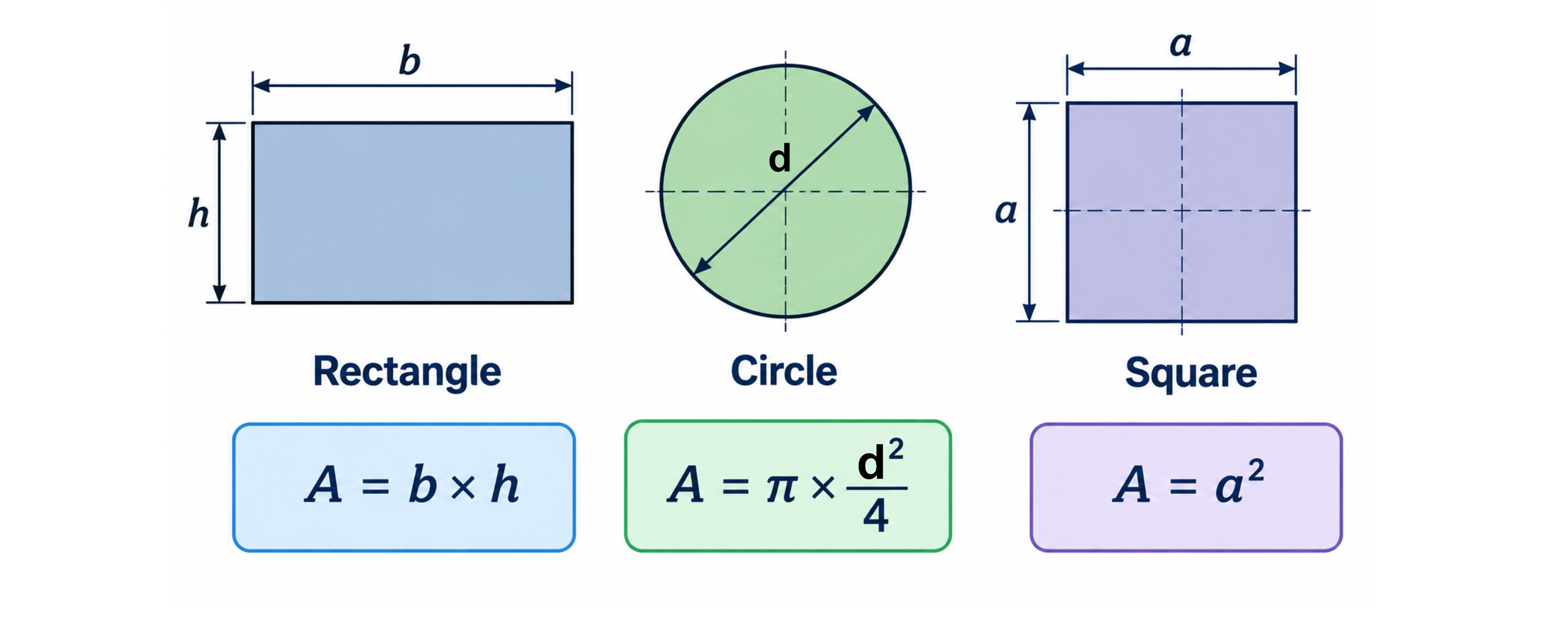
A square bar of 20 mm × 20 mm cross-section is subjected to a tensile load of 500 N. Calculate the stress in the bar.
A column of cross-section 0.25 m² has a maximum allowable stress of 50 N/mm². Calculate the maximum compressive load.
A steel wire supports a load of 8 kN. The stress must not exceed 200 N/mm². Find the minimum wire diameter required.
d² = 4Aπ = 4 × 40π = 50.93
d = √50.93 = 7.14 mm
Show all working. Check units carefully — forces in N, areas in mm², stress in N/mm².
Section 5: Strain
Every material deforms slightly when a force is applied to it — it stretches under tension or shortens under compression. This change in length, expressed as a proportion of the original length, is called strain. Strain tells us how much a material has deformed relative to its size.
Δlεl formula triangle. It works exactly like the stress triangle: cover the quantity you want. Cover ε and you see Δl over l; cover Δl and you see ε next to l, so multiply.
Metres or millimetres?
Length (l) is measured in metres (m), so the original length of a member is usually given in m. The change in length (Δl), however, is often tiny and is usually given in mm.
Because strain is one length divided by another, the units cancel out. As long as Δl and l are in the same unit, the calculation works — you get exactly the same answer whether you use metres or millimetres.
When the change in length is a small decimal in mm (for example 0.06 mm), converting it to metres gives a number full of zeros (0.00006 m), and it is very easy to lose or add one. In that case it is often less confusing to convert the original length to mm instead, and work entirely in millimetres.
Tensile and compressive strain
If a member is under tension (being stretched), Δl is an increase in length — the strain is positive. If a member is under compression (being shortened), Δl is a decrease in length — the strain is sometimes described as compressive.

A steel wire of length 5 m stretches 2.5 mm when a load is applied. Calculate the strain.
ε = 0.00255 = 0.0005
ε = 2.55 000 = 0.0005
The allowable strain on a concrete column must not exceed 5 × 10⁻⁴. The column is 3 m tall. Find the maximum reduction in height.
A mass of 2 500 kg is hung from a vertical steel bar. The bar has a rectangular cross-section of 75 mm × 50 mm and an original length of 0.5 m. The bar stretches by 2.5 mm. Calculate both the stress and the strain. (Use g = 9.81 m/s².)
ε = 2.5500 = 0.005
Show all working. Remember: Δl and l must be in the same unit before dividing — if the change in length is a small decimal in mm, it is often easier to convert l to mm. State clearly that strain has no units.
Section 6: Design Challenges
These challenges bring everything together: choosing a material, justifying it against a specification, sizing a part using stress, and checking a prototype using strain. They follow the same shape as an assignment task — a context, a numbered specification, then design, test and evaluate. Work through each part in order and refer back to the specification by number when you justify or evaluate.
Design Challenge 1: Café sign hanger rods
A café on a seafront promenade wants a heavy wooden sign to hang from a bracket above its door. The sign will hang from two round rods, each 0.4 m long, which will be in tension. You have been asked to choose a material for the rods and work out what size they need to be. The rods must meet the following specification:
| i | Each rod must carry a tensile force of 1 200 N. |
| ii | The stress in each rod must not exceed 60 N/mm². |
| iii | The rods must survive in salty, damp sea air for at least 10 years without significant corrosion. |
| iv | The strain in each rod must not exceed 0.0004. |
Design Challenge 2: Community garden planter legs
A community garden is building raised planters at wheelchair height so that everyone can reach the soil. Each planter stands on four square legs, each 0.6 m tall, which will be in compression. When full of wet soil, the load on each leg is 6 000 N. The legs must meet the following specification:
| i | Each leg must carry a compressive force of 6 000 N. |
| ii | Each leg must have a square cross-section no bigger than 100 mm × 100 mm so it fits the frame. |
| iii | The legs must not rot or corrode while standing on damp ground for many years. |
| iv | The legs should be made from recycled material wherever possible. |
| v | Each leg must not shorten by more than 0.3 mm under full load. |
The garden has three materials it could use. The allowable compressive stress is the highest stress each material should be designed to carry.
| Material | Allowable compressive stress | Notes |
|---|---|---|
| Softwood timber | 7 N/mm² | Cheap and easy to cut; rots in damp ground unless treated |
| Recycled plastic lumber (HDPE) | 2 N/mm² | Made from 100% recycled plastic; does not rot |
| Glass fibre composite (GRP) | 40 N/mm² | Very strong and does not rot; difficult to recycle and expensive |